

Completeness of Patient Status Reporting in Integrated Results Reporting and Data System During the Bundibugyo Ebola Outbreak Response, Uganda, May– August 2026
Authors: Martha Nakaye1,2*, Nambazira Farida1, Patrick Pithua1, Caroline Musubiika1, Florence Nambaziira1, Nakaweesa Vivian1, Masaba Robert 1Aya Irene1, Charity Jurua1, Godfrey Manirakiza1, Nantale Miriam1, Nalwanga Rebecca1 Prossy Nabateregga3, Carol Makoha3 Samuel Gidudu1 Institutional affiliations: 1 Uganda Public Health Fellowship Program, Uganda National Institute of Public Health, Ministry of Health, Kampala, Uganda 2 World Alliance for Lung and Intensive Care Medicine in Uganda, Kampala, Uganda 3 National Health Laboratory and Diagnostic Services, Kampala, Uganda Correspondence: Tel: +256 774 845614, Email: marthejo27@uniph.go.ug

Summary
Background: Complete patient-status information is essential for monitoring outcomes and supporting case follow-up during outbreak response. During the Bundibugyo Ebola outbreak, declared on 15 May 2026, routine review of the Integrated Results Reporting and Data System (IRRDS) identified a high proportion of records with unknown patient status. On 11 June 2026, national rapid response teams (NRRT) were deployed and initiated targeted follow-up with districts to complete missing patient-status information in IRRDS. We assessed changes in the completeness of patient-status reporting before and after deployment of the NRRTs, May to August 2026.
Methods: A descriptive before-and-after analysis of all routine laboratory surveillance records was conducted in IRRDS. Patient status in IRRDS was categorized as alive, dead, or unknown. The proportion of records with unknown patient status before 11 June 2026 was compared with the proportion after deployment of National rapid response teams between May to August 2026.
Results: A total of 3,429 records were assessed. Before 11 June 2026, 361 of 1,236 records (29.2%, 95% CI: 26.7–31.8) had unknown patient status. Following deployment of the National rapid response teams and initiation of targeted district engagement, 134 of 2,193 records (6.1%, 95% CI: 5.2–7.2) had unknown status. This represented a 23.1% absolute reduction (95% CI: 20.4–25.8) and an approximately 79.1% relative reduction (95% CI: 74.8–82.6%) in unknown-status reporting. The difference in proportions was statistically significant (χ² = 341.4, df = 1, p < 0.001; two-proportion z-test, z = 18.5, p < 0.001).
Conclusion: A substantial improvement in completeness of patient-status reporting was observed following deployment of the National rapid response teams and targeted district engagement. Routine identification of incomplete records coupled with active follow-up of reporting districts may strengthen data quality during outbreak response.
Introduction
On 15 May 2026, Uganda declared an outbreak of Bundibugyo Ebola virus disease following confirmation of imported cases from the Democratic Republic of the Congo. Laboratory testing and related patient information were captured in the Integrated Requests and Results Dispatch System (IRRDS), a national electronic platform used to manage laboratory requests and results [1,2,3].
Routine review of IRRDS data during the outbreak identified a high proportion of records with patient vital status recorded as unknown. Because complete patient-status information is important for patient follow-up, mortality surveillance, and interpretation of outbreak data, National rapid response teams (NRRT) were deployed on 11 June 2026 to review incomplete records, engage reporting districts and update patient status in IRRDS.
We assessed changes in the proportion of records with unknown patient status before and after deployment of the NRRTs.
Methods
We conducted a descriptive before-and-after analysis of routine laboratory surveillance records captured in the Integrated Requests and Results Dispatch System (IRRDS) during the Bundibugyo virus disease outbreak. Data were extracted on 14 August 2026. Integrated Results Reporting and Data System (IRRDS) records were generated from health facilities that initiated specimen requests and four testing laboratories: Central Emergency Response and Surveillance Laboratory, CERSL Wandegeya, Uganda Virus Research Institute Viral Hemorrhagic Fever Laboratory Entebbe, Uganda Virus Research Institute, UVRI Laboratory Arua, and Bwera Mobile Laboratory. The patient-status field analyzed was obtained from laboratory-associated records in IRRDS.
Of 3,483 records in the extracted dataset, 3,429 (98.4%) with a valid sample collection date were included; 54 (1.6%) without a collection date were excluded because they could not be classified by intervention period. Included records had sample collection dates from 6 May to 12 August 2026. Records were checked for duplicates using patient name, sample collection date, district, and health facility; no complete duplicates were identified.
Patient vital status was categorized as alive, dead, or unknown. “Unknown” included records recorded as unknown, not indicated, blank, or otherwise lacking an affirmative alive or dead status. The primary outcome was the proportion of records with unknown patient status.
National rapid response teams were deployed on 11 June 2026 to 58 of the 107 districts referring specimens to the reference testing laboratories. Records were classified as pre-intervention if the sample was collected before 11 June 2026 and post-intervention if collected on or after 11 June 2026. We calculated the number and proportion of records with unknown status in each period, with 95% confidence intervals, and estimated absolute and relative changes between periods. Differences in proportions were assessed using a two-proportion test, with p<0.05 considered statistically significant.
The investigation was conducted as part of the Ministry of Health public health response. The Ministry provided administrative clearance, and the U.S. Centers for Disease Control and Prevention determined the activity to be non-research because its primary purpose was public health disease control.
Results
Out of 3,429 records 1,648 (48.1%) were as Alive, 1,286 (37.5%) as Dead, and 495 (14.4%) as Unknown. The National rapid response teams were deployed to 58 of 107 districts referring samples to the testing laboratories. Before 11 June 2026, 361 of 1,236 records (29.2%, 95% CI: 26.7–31.8) had unknown patient status. On or after 11 June 2026, following deployment of the National rapid response teams, 134 of 2,193 records (6.1%, 95% CI: 5.2–7.2) had unknown status, with a 23.1% absolute reduction (95% CI: 20.4–25. 8) and a 79.1% relative reduction (95% CI: 74.8–82.6) in unknown-status reporting. The difference in proportions was statistically significant (χ² = 341.4, df = 1, p < 0.001; two-proportion z-test, = 18.5, p < 0.001).
The post-deployment period included more records (n = 2,193) than the pre-deployment period (n = 1,236).
Discussion
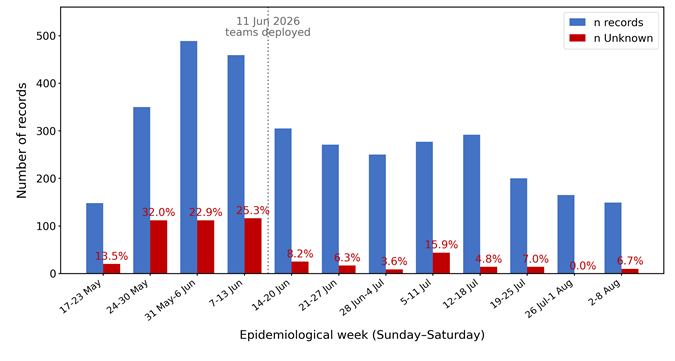
This analysis showed a substantial improvement in completeness of patient-status reporting in IRRDS following deployment of National rapid response teams and targeted district engagement on 11 June 2026. The proportion of records with unknown patient status declined from 29.2% before deployment to 6.1% afterward, representing a 79% relative reduction. The decline occurred despite a larger number of records in the post-deployment period, suggesting that the improvement was not simply due to lower reporting volume.
Weekly trends were generally consistent with the overall improvement, although a temporary increase in unknown-status reporting was observed during 5–11 July 2026. This suggests that improvements in data completeness may not be sustained automatically and require continued monitoring and follow-up [4]. Unknown status reporting also varied across districts, indicating that some districts experienced more persistent data-quality gaps than others.
Study limitations: Because this was a retrospective before-and-after analysis, the observed improvement cannot be attributed solely to deployment of the National rapid response teams. Other concurrent outbreak-response activities, changes in reporting practices, or differences in sample volume may also have contributed [5]. In addition, classification was based on sample collection date rather than the date on which patient-status records were reviewed or updated, which limits precise attribution of changes to the intervention.
Conclusion: Unknown reporting in IRRDS declined substantially after 11 June 2026, from 29.2% to 6.1%. Although the design does not establish causality, the findings indicate that routine data-quality monitoring combined with targeted district follow-up can contribute to improved completeness of laboratory surveillance data during outbreak response.
Routine data-quality monitoring should be strengthened in IRRDS, with automated identification of incomplete patient-status records and regular feedback to reporting districts. Active follow-up of incomplete records should be incorporated into National rapid response team activities during outbreaks, with additional support directed to districts with persistent reporting gaps.
Conflict of Interest: The authors declare that they had no conflict of interest.
Authors’ contribution: MN, NF designed the study and data analysis with guidance from SN, SG, ARA and PP, CM. KN, FN, NV, MR, AI, CJ, GM, NM, NR, RN did data collection SN. MC and SG participated in bulletin review to ensure scientific integrity and intellectual content. All authors agreed to the submission of the article.
Acknowledgements: We acknowledge the U.S Centers for Disease. and Prevention Uganda through Makerere School of Public Health and Baylor Uganda for technical and implementation support. Their collaboration, expertise and dedication were key in effectively responding to the crisis and protecting public health.
Copyright and licensure: All materials in the Uganda Public Health Bulletin are in the public domain and may be used and reprinted without permission, citation as a source is however appreciated. Any article can be reprinted or published. If cited as a reprint it should be referenced in the original form.
References
- Nyaga, R., Mushabe, D., & McCarroll, M. (2026, August 6). Digital transformation of Uganda’s Ebola outbreak response through IRRDS and Result Track systems. Association of Public Health Laboratories.
- Ministry of Health Uganda. (2026, May 15). Press statement on the declaration of the Bundibugyo Ebola virus disease outbreak in Uganda. Ministry of Health – Uganda
- Uganda Ministry of Health. (n.d.). Integrated Requests & Results Dispatch System (IRRDS). National Health Laboratory and Diagnostic Services (UNHLDS/CPHL). https://irrds.cphl.go.ug/
- World Health Organization. (2004). Overview of the WHO framework for monitoring and evaluating surveillance and response systems for communicable diseases. Weekly Epidemiological Record, 79(36), 322–326.
- Ministry of Health Uganda. (2021). Technical guidelines for Integrated Disease Surveillance and Response (IDSR) (3rd ed.). Ministry of Health – Uganda. https://library.health.go.ug/file-download/download/public/817

Comments are closed.