

Prolonged Laboratory Result Turnaround Time During a Suspected Food Poisoning Outbreak Investigation, Nakaseke District, Uganda, February–March 2026
Authors: Marthe Nakaye1,2*, Masaba Robert 1,3, Godfrey Manirakiza 1, 4, Babirye Yunia5 Rose Akidde6, Susan Nabadda7, Samuel Gidudu1 and Alex Riolexus Ario1 Institutional affiliations: 1 Uganda Public Health Fellowship Program, Uganda National Institute of Public Health, Ministry of Health, Kampala, Uganda; 2 World Alliance for Lung and Intensive Care Medicine in Uganda, Kebera Diagnostic Laboratories Kampala, Uganda; 3 Bombo Military Hospital, Bombo, Uganda; 4 Uganda Peoples Defence Forces National Referral Hospital, Mbuya Kampala, Uganda; 5 Nakaseke Hospital, Nakaseke District Local Government, Nakaseke, Uganda; 6 Uganda Virus Research Institute, Entebbe, Uganda; 7National Health Laboratory and Diagnostic Services, Ministry of Health, Kampala Uganda Correspondence: Tel: +256 774 845614, Email: marthejo27@uniph.go.ug

Summary
Background: On 6 February 2026, a food-poisoning event occurred among mourners in Nakaseke district who had travelled to Mukono district. Thirty-eight people developed acute gastrointestinal symptoms, and four were admitted to Ssemuto Health Centre IV. Specimens were referred to an inappropriate laboratory, and results were returned after 23 days, exceeding the recommended 48–72-hour turnaround time by approximately 20 days. We investigated the causes of the prolonged turnaround time in Nakaseke District during February–March 2026.
Methods: We conducted a field investigation in 10 of 19 high-volume health facilities in Nakaseke District. Eleven key informant interviews and three focus group discussions involving 27 laboratory personnel were conducted to identify factors contributing to delayed specimen referral and testing. Findings were organized into personnel, process, coordination, and resource domains using a fishbone framework. Potential root causes were prioritized through consensus and used to guide targeted interventions.
Results: Key root causes included absence of test-specific request forms, lack of a specimen-referral register, an inactive district laboratory pillar, and limited awareness of the National referral-laboratory testing capacity. Only four of the 38 symptomatic persons had specimens collected because of shortages of sample-collection materials, and specimens were initially referred using an inappropriate viral haemorrhagic fever request pathway.
Conclusion: Weak district laboratory coordination was a major contributor to prolonged turnaround time. Following the investigation, specimens were redirected to the appropriate referral laboratory, and 29 laboratory personnel from the 10 assessed facilities received onsite mentorship on national referral-testing pathways and requirements.
Introduction
Food poisoning is an important public health problem caused by consumption of food or water contaminated with biological, chemical, or toxic agents. Globally, foodborne diseases cause an estimated 600 million illnesses and 420,000 deaths annually. In Uganda, common bacterial causes include Salmonella, Escherichia coli, and Shigella species. [1,2].
On 6 February 2026, 38 mourners from Kaber LC1, Kapeeka Sub-county, Nakaseke District developed diarrhoea, abdominal pain, and vomiting after attending a burial in Mukono District. Four were admitted to Ssemuto Health Centre IV. Specimens were collected but were referred to the Uganda Virus Research Institute using a viral haemorrhagic fever request form rather than the appropriate microbiological and toxicological testing pathway. Laboratory results were returned after 23 days, beyond the expected 48–72-hour turnaround time. We investigated the causes of the prolonged turnaround time and identified opportunities to strengthen specimen referral and laboratory coordination in Nakaseke District February–March 2026.
Methods
We conducted the investigation in Nakaseke district, central Uganda. Of 19 health facilities with laboratory services, 10 high-volume facilities involved in specimen collection and referral during the outbreak were purposively selected. Ssemuto HCIV was the primary care facility, while Ngoma HCIV served as the district specimen-transport hub [3]. We interviewed the District Laboratory Focal Person, laboratory managers, the hub coordinator, and laboratory staff on specimen collection, referral, transportation, documentation, turnaround-time monitoring, and result communication. We also reviewed referral registers, logbooks and case investigation forms, and using a fishbone framework, contributing factors were grouped into personnel, process, coordination, and resource-related causes, and the Five Whys technique was used to explore underlying failures. The Ministry of Health provided administrative clearance, and the U.S. CDC determined the activity to be non-research because it was conducted for public health disease control
Results
Facility-level assessment findings: Across the 10 assessed facilities, 75% of staff were competent in sample management and referral, though 10% of newly recruited staff needed refresher training. Case investigation forms were absent, and only 1 facility had a sample referral register. Samples generally followed routine transport to the Hub Coordinator, but delays and inadequate packaging supplies were reported.
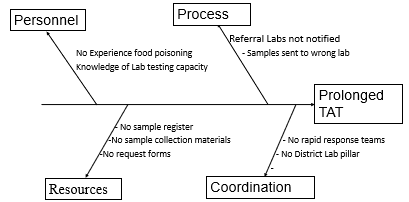
Root Cause Analysis Findings: Contributing factors spanned all four RCA domains. Personnel: Ssemuto HCIV staff lacked experience with food poisoning protocols and knowledge of appropriate referral laboratories; staffing shortages were noted at six other facilities. Process: Ssemuto HCIV had no sample register or food-poisoning-specific request forms, prompting improvised use of VHF forms; specimens were sent to UVRI without a specified department instead of CPHL Microbiology or DGAL, with a VHF panel ordered instead of the correct workup, pushing TAT past 72 hours. Coordination: The testing laboratory received no advance notification, the District Laboratory Pillar was inactive, no rapid response teams existed, and outbreak information was held informally by individual staff rather than logged. Resources: Collection containers and forms were unavailable, key equipment (refrigerator, microscope) were non-functional, and district-level awareness of national testing capacity was lacking, contributing to specimen misdirection.
Discussion
The investigation identified important weaknesses in specimen collection, referral, and laboratory coordination that contributed to prolonged turnaround time. Only 4 of 38 symptomatic persons had specimens collected because of shortages of collection materials, and the causative agent was not confirmed. Across the assessed facilities, case investigation forms were unavailable and specimen-referral registers were largely absent, indicating broader district-level preparedness gaps [4].
The prolonged turnaround time resulted from combined weaknesses in personnel knowledge, referral processes, coordination, and resources. Specimens were sent to an inappropriate laboratory using the wrong testing pathway, pre-notification was inadequate, and the District Laboratory Pillar was inactive. These findings suggest that the delay reflected systemic laboratory preparedness weaknesses rather than a single isolated error [5].
Study limitations: The assessment also relied partly on staff interviews and incomplete facility records. Because the investigation focused on a single event, the sustainability and long-term effect of the interventions could not be assessed.
Conclusion: Prolonged laboratory turnaround time during the Nakaseke food-poisoning event was driven by gaps in specimen referral, coordination, documentation, staff knowledge, and supplies, with the inactive District Laboratory Pillar identified as a key systemic weakness. We recommend strengthening capacity across health facilities nationwide through regular mentorship and training on the National Laboratory Guidelines for Outbreak Preparedness and Response, with emphasis on appropriate specimen collection, referral pathways, laboratory pre-notification, and coordination during outbreaks. To sustain timely outbreak response, we recommend establishing a national protocol requiring referral laboratories, including UVRI, CPHL, and DGAL, to routinely communicate turnaround-time information for emergency specimens to district laboratory focal persons and hub coordinators.
Public Health Actions: The district and national laboratory teams initiated corrective actions, including stakeholder engagement, development of a short-term district action plan, emergency procurement of essential specimen-collection supplies, improved referral guidance, and mentorship of 29 laboratory personnel across the 10 assessed facilities.
Conflict of Interest: The authors declare that they had no conflict of interest.
Authors’ contribution: MN and MR designed the study and data analysis with guidance from SN, SG and MN. MR, GM, BY did data collection RA, SG participated in bulletin review to ensure scientific integrity and intellectual content. All authors agreed to the submission of the article.
Acknowledgements: We acknowledge the U.S Centers for Disease Control and Prevention Uganda through Makerere University School of Public Health and Baylor Uganda for technical and implementation support. We extend our heartfelt gratitude to all the stakeholders and partners for their vital roles in managing the food poisoning outbreak. Their collaboration, expertise and dedication were key in effectively responding to the crisis and protecting public health.
Copyright and licensure: All materials in the Uganda Public Health Bulletin are in the public domain and may be used and reprinted without permission, citation as a source is however appreciated. Any article can be reprinted or published. If cited as a reprint it should be referenced in the original form.
References
- World Health Organization. (2015). WHO estimates of the global burden of foodborne diseases: Foodborne disease burden epidemiology reference group 2007–2015. World Health Organization. https://apps.who.int/iris/handle/10665/199350
- World Health Organization. Regional Office for Africa. (2008). Strengthening public health laboratories in the WHO African Region: A critical need for disease control. World Health Organization. Regional Office for Africa.
- Ministry of Health (MoH) Uganda Master Facility List (MFL) & Nakaseke District Health Office Annual Health Reports. 2021-2022
- Gehre, F., Lagu, H., Achol, E., Omari, N., Ochido, G., Duraffour, S., Hinzmann, J., Kezakarayagwa, E., Kabatesi, F., Nkeshimana, A., Nyandwi, J., Samson, D. D., Nykwec, G. A., Lokore, M. L., Deng, L. L., Kelly, M. E., Mkama, P. B. M., Magesa, A., Beyanga, M., Roba, A., Ndia, M., Lokamar, P., Kiiru, J., Kabanda, A., & Mukagatare, I. (2022). The East African Community’s mobile laboratory network’s rapid response during the first 2 weeks of the Ebola Sudan virus disease (SVD) outbreak in Uganda and pandemic preparedness activities in South Sudan, Rwanda, Tanzania, Burundi, Kenya. BMJ Global Health, 7(12), e011073. https://doi.org/10.1136/bmjgh-2022-011073
- Ministry of Health Uganda and NHLDS, 2026. National Laboratory Guidelines for Preparedness and Response to Public Health Emergencies. Kampala: Ministry of Health. Available at: https://cphl.go.ug/library-resource [Accessed 14 August 2026].

Comments are closed.