

Healthcare–seeking behaviour among caregivers of children with suspected measles in Kyegegwa District, Uganda, January–April 2026
Authors: Elizabeth Nshabohurira1*, Godfrey Tumwizere1, Regina Nanyunja1, Mariam Nambuya1, Allan Amandu1, Rodgers Kalanda1, Lillian Aliyinza1, Prossy Nakito1, Chrispus Musabe Bakunda1, Wilber Arineitwe1, Richard Migisha1, Benon Kwesiga1, Yasiini Nuwamanya2 Institutional affiliations: 1Uganda Public Health Fellowship Program, Uganda National Institute of Public Health, Ministry of Health, Kampala, Uganda, 2Uganda National Expanded Program on Immunization, Ministry of Health, Kampala, Uganda Correspondence*: Tel:+256779422355, enshabohurira@uniph.go.ug

Summary
Background: On March 20, 2026, the Ministry of Health confirmed a measles outbreak in Kyegegwa District after five of six samples from suspected measles cases tested positive with one death reported. We described healthcare-seeking behaviour and identified factors associated with delayed formal care-seeking among caregivers of children with suspected measles during the outbreak investigation, January–April 2026.
Methods: We conducted a mixed-methods cross-sectional study among 85 caregivers of children with suspected measles identified during active case search in the two most affected sub-counties. We used structured questionnaires to collect quantitative data from caregivers. Qualitative data were collected through interviews with four community caregivers and two Village Health Team (VHT) members. We defined delayed formal healthcare-seeking as seeking care at a health facility more >48 hours after rash onset or not seeking formal care. We defined a caregiver as knowledgeable if they could name >2 symptoms of measles based on the community case definition of measles. We used logistic regression to identify factors associated with delayed care-seeking.
Results: Among 85 caregivers, 53 (62%) delayed seeking formal healthcare. Only 24 (28%) first sought care at a health facility. The remaining caregivers first used home remedies (31; 36%), sought care from traditional healers or used traditional herbs (15;18%), purchased medicines from drug shops or private clinics (9; 11%), did nothing (4; 5%), or first consulted a VHT (2;2%). Delay was associated with caregiver knowledge of measles (adjusted odds ratio (aOR)=5.28; 95% confidence interval (CI): 1.63–17.16). and travel time ≥60 minutes to reach a health facility had higher odds of delayed care-seeking (aOR=4.93; 95% CI: 1.50–16.12). Qualitative findings added care at home, herbal remedies, advice from relatives, transport costs, medicine stock-outs and long waiting times.
Conclusion: Delayed care-seeking were attributed to home-based treatment, sociocultural, geographic, financial, and health-system barriers. Interventions aimed at addressing community level and health-system factors could help reduce delays.
Background
Measles is a highly contagious viral disease spread through respiratory droplets or direct contact [1] . Despite having a safe and effective vaccine, it remains an important cause of death among young children globally, and can cause serious adverse outcomes such as blindness, pneumonia and encephalitis [2] .
Healthcare-seeking behaviour is any action or inaction undertaken by individuals who perceive themselves to be ill, to find an appropriate remedy [3] . Early and appropriate health-seeking behaviour among measles case-patients enables prompt clinical assessment, supportive treatment, management of complications, case notification, investigation, and contact tracing [4] .
Delayed care-seeking of suspected measles may increase the risk of complications and continued community transmission [5] . In rural Uganda, caregivers commonly begin treating childhood illness at home with traditional or herbal remedies before seeking formal care, influenced by cultural beliefs, family advice, and confidence in traditional medicine [6] .
On March 20, 2026, Ministry of Health (MOH) confirmed a measles outbreak in Kyegegwa District after five of six samples from suspected measles cases tested positive with one death reported. Confirmed cases were reported from Ruhangire Parish, Rwentuha Sub-county, where preliminary findings suggested immunisation gaps and delayed or absent healthcare-seeking at health facilities. We determined the healthcare-seeking behaviour and identified associated factors among caregivers of children with suspected measles in Kyegegwa District, Uganda from January to April 2026.
Methods
Kyegegwa District, in Toro sub-region, has a population of 501,120 [7] , and has a mixed health service delivery system comprising government health centres at levels II through IV, one district hospital, and private not-for-profit facilities.
We conducted a cross-sectional mixed methods study in the two most-affected sub-counties, Kasule and Rwentuha. A total of 85 caregivers were identified through active case finding and assessed based on availability. A caregiver was defined as the person primarily responsible for a child with suspected measles. A suspected case of measles was defined as fever and a maculopapular rash with at least one of the following symptoms: cough, coryza (runny nose), or conjunctivitis (red eyes) in a resident of Kyegegwa District from January to April, 2026.
Caregivers of cases were interviewed on caregiver and child characteristics plus potential risk factors for delay to seek formal healthcare. We defined knowledge as knowing >2 symptoms of measles by the care givers. Key informant interviews with VHTs explored community care-seeking patterns, barriers and enablers to early healthcare-seeking. We used logistic regression to assess the association with delayed care-seeking and inductive thematic analysis for qualitative data.
We conducted this study in response to the outbreak in Kyegegwa District with permission from Ministry of Health Uganda and district health authorities. A non-research determination was obtained from the Associate Director for Science, US CDC Uganda. Verbal informed consent was obtained from all participants prior for clarity and easy communication. Participation was voluntary and confidentiality was maintained by anonymising data and secure handling throughout.
Results
Descriptive characteristics among suspected measles cases and caregivers in Rwentuha and Kasule sub counties in Kyegegwa District, January–April 2026
A total of 85 caregivers participated in the quantitative survey. Of these, 75 (88%) were female. The median age of care givers was 34 years. Most caregivers attained primary-level education 51(60%). Most caregivers were engaged in farming 78(92%). The median age of the children with suspected measles was 46 months, with most aged 18–59 months.
First action taken by caregivers of children with suspected measles after symptom onset in Rwentuha and Kasule sub counties, Kyegegwa District, January–April 2026
The most common initial action was using home remedies (Figure 1).
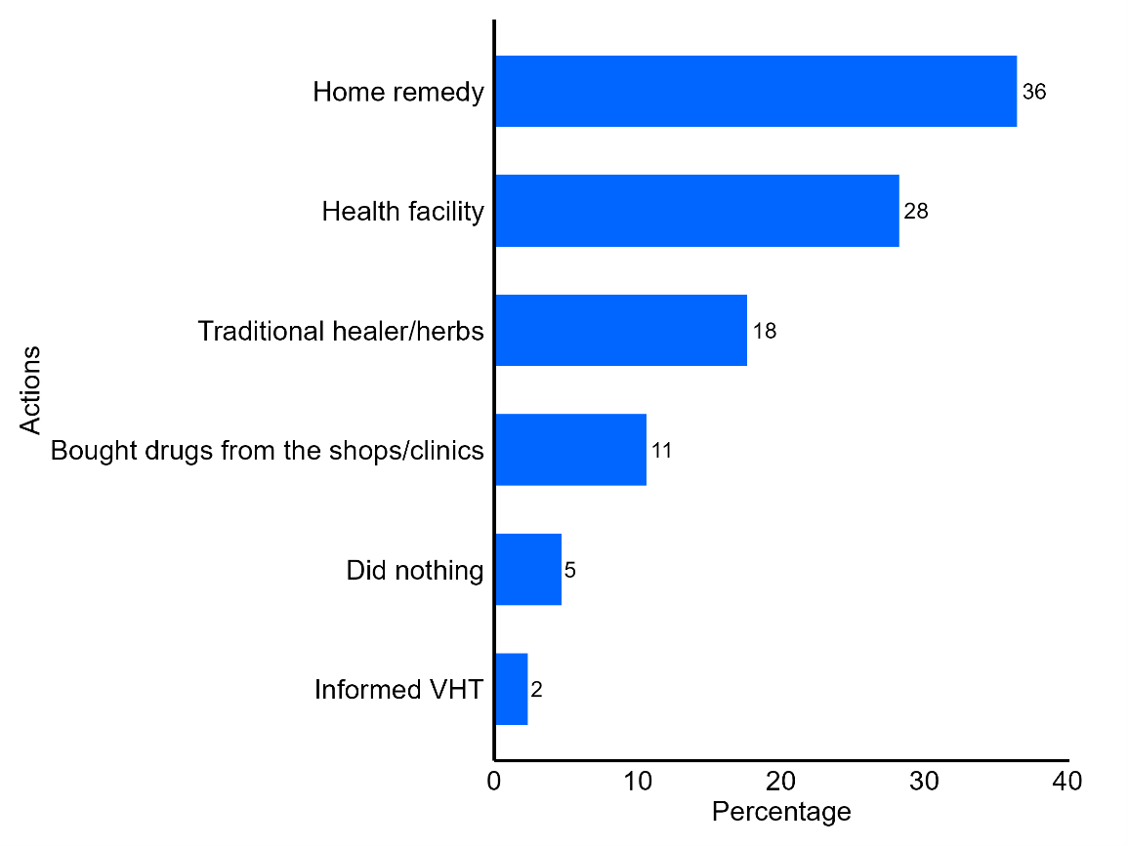
Delayed healthcare-seeking among caregivers of children with suspected measles, Rwentuha and Kasule sub counties, Kyegegwa District, January–April 2026
Nearly two-thirds of caregivers delayed seeking formal healthcare for children with suspected measles.
Table 1: Factors associated with delay in seeking formal care among caregivers of children with suspected measles, Kyegegwa District, Uganda, January–April 2026
| Characteristic | Total n (%) | Delayed n (%) | cOR | aOR |
| Time taken to reach nearest health facility | ||||
| 0-59 minutes | 52 (61) | 28 (54) | ref | ref |
| 60 and above minutes | 33 (39) | 25 (76) | 2.68(1.02-7.02) | 4.93(1.50-16.12) |
| Caregiver knowledge | ||||
| Yes | 50 (59) | 37 (74) | 3.38(1.35-8.45) | 5.28(1.63-17.16) |
| No | 35 (41) | 16 (46) | ref | ref |
cOR: Crude odds ratio; aOR: Adjusted odds ratio; ref: Reference category
Time taken to travel to the health facility of ≥60 minutes was associated with over 4 times the odds of delay (aOR=4.93, 95% CI:1.50-16.12, p=0.008). Caregiver knowledge about measles was similarly associated with increased odds of delay in seeking formal healthcare (aOR=5.28, 95% CI:1.63-17.16, p=0.006) (Table 1).
Qualitative factors associated with delay in seeking formal care among caregivers of children with suspected measles in Rwentuha and Kasule sub counties, Kyegegwa district, January–April, 2026
Caregivers described several factors contributing to delayed healthcare seeking, including home-based treatment, use of herbal remedies, advice from relatives, transport costs, medicine stock-outs, and long waiting times. These findings illustrate the range of experiences reported by the caregivers of children with suspected measles.
Home management of measles first: Most caregivers first managed the child at home, and sought formal care when only when symptoms persisted or worsened. One caregiver explained, “I first gave her panadol and then looked for herbs….”
Herbal medicine as an important alternative treatment: Both caregivers and VHTs commonly described treating children with suspected measles at home with herbal medicine and taken to the later for final management, a practice called “omutasyo”.
“Most of the people know the herbs and get them themselves. The process of using herbs is called ‘omutasyo’. When they get better, that is when they are taken to the hospital to check if they healed...” (VHT)
Perceived severity of the disease: Caregivers sought facility care mainly once illness appeared severe for example, a child with fever, vomiting, and bloody diarrhoea. Milder symptoms were treated with herbs alone after the fever subsided. One caregiver explained,
“She was not very sick so I got for her herbs and the rash started drying, so I didn’t see the use since the fever was gone” (Caregiver)
Structural, economic, and health-system barriers: Distance to health facilities, cost of transport, were frequently mentioned as challenges, particularly for households with limited financial resources. One VHT noted, “…caregivers can be lazy because of distance, may not have money for transport”. Caregivers also described medicine shortages, long waits, understaffing, and referrals to other government facilities, as well as poor road conditions during heavy rain, as further deterrents.
Community influence: Family members, friends, neighbours, and other community members shaped care-seeking decisions. One caregiver explained, “I talked to my mother and explained to her how the children were, she told me to get herbs…”.
VHTs as facilitators: VHTs identified suspected cases, educated caregivers, referred children to facilities, wrote referral notes when caregivers reported illness to them and followed up. One VHT reported, “When one is sick, they report to us and we inform the in-charge, then write a referral note for them to go to the hospital…”
Discussion
Delayed care-seeking for suspected measles appeared to reflect an interaction of geographic, sociocultural, financial, and health-system factors. Long travel times can discourage or postpone use of formal healthcare, particularly in rural and hard-to-reach communities, as reported in other African settings.
Caregiver knowledge of measles did not necessarily translate into earlier formal care-seeking. Similar findings have been reported elsewhere, suggesting that knowledge alone may be insufficient to promote timely healthcare use [8–10] . Caregivers who recognize measles may initially feel confident managing the illness at home and seek facility care only when symptoms worsen [8–11] . Health education should therefore emphasize not only recognition of measles but also the importance of early assessment and danger signs requiring prompt referral.
Home remedies and traditional treatments were commonly influenced by advice from relatives and community members, reflecting the role of family and social norms in care-seeking decisions [6,9] . Decisions to seek formal care were further influenced by distance, transport costs, poor road conditions, waiting times, medicine availability, and perceptions of service quality, consistent with evidence from other African settings [10,12–15] .
Village Health Teams can help address some of these barriers through community education, early identification of suspected cases, referral, and follow-up. Strengthening their role may support earlier linkage of children with suspected measles to appropriate health services [16] .
Study limitation: The study included only caregivers of suspected measles cases identified during the outbreak, resulting in a relatively small sample. Small numbers in some variable categories reduced the precision of association estimates, and the findings may not be generalizable beyond the outbreak setting.
Conclusion: Delayed care-seeking for suspected measles was influenced by home-based treatment practices, social and cultural influences, geographic and financial barriers, and health-system factors. Addressing both community- and health-system barriers is important for promoting timely care-seeking during measles outbreaks.
Health authorities should strengthen VHT-led community education and referral, emphasize the risks of delaying formal care for suspected measles, and address misconceptions about home and traditional treatment. Health facilities should also improve availability of essential medicines, adequate staffing, and timely service delivery to reduce barriers to early care-seeking.
Acknowledgement: We thank Kyegegwa District Local Government, the participating community, Ministry of Health, Uganda National Expanded Program for Immunisation (UNEPI), and Uganda Public Health Fellowship Program for their support.
Author contributions: EN led conceptualisation, data collection, analysis and writing. GT, RN, MN, AA, RK, LA, PN, CMB and WA were involved in the investigation and data collection. BK, RM and YN provided supervision.
Conflict of interest: The authors have no competing interests to declare.
Copyrighting and licensing: All materials in the Uganda Public Health Bulletin are in the public domain and may be used and reprinted without permission. However, citation as to source is appreciated. Any article can be reprinted or republished. If cited as a reprint, reference the original form.
References
[1] How Measles Spreads | Measles (Rubeola) | CDC n.d. https://www.cdc.gov/measles/causes/index.html (accessed June 6, 2026).
[2] Rachlin A, Danovaro-Holliday MC, Murphy P, Sodha S V, Wallace AS. Routine Vaccination Coverage — Worldwide, 2021. MMWR Morb Mortal Wkly Rep 2022;71. https://doi.org/10.15585/mmwr.mm7144a2.
[3] The state of the world’s children: for every child, vaccination. UNICEF Innocenti – Global Office of Research and Foresight; 2023.
[4] Measles Outbreak Guide. World Health Organization; 2022.
[5] Ibraheem RM, Ibrahim OR, Aliu R, Bello AO, Ogunkunle TO, Abdulkareem KA, et al. Complications and Outcomes of Children Hospitalized with Measles in Nigeria: A Multi-Center Study. n.d.
[6] Hooft A, Nabukalu D, Mwanga-Amumpaire J, Gardiner MA, Sundararajan R. Factors motivating traditional healer versus biomedical facility use for treatment of pediatric febrile illness: Results from a qualitative study in Southwestern Uganda. American Journal of Tropical Medicine and Hygiene 2020; 103:501–7. https://doi.org/10.4269/ajtmh.19-0897.
[7] UBOS. National Population and Housing Census 2024. 2024.
[8] Munetsi T, Chirundu D, Chadambuka A, Juru TP, Shambira G, Gombe NT, et al. Measles outbreak: knowledge, vaccine hesitancy, health-seeking practices among caregivers of children with measles and factors associated with measles transmission in Sanyati District, Zimbabwe, 2022. PAMJ 2025; 51:18 2025;51. https://doi.org/10.11604/PAMJ.SUPP.2025.51.1.47864.
[9] Mpimbaza A, Nayiga S, Ndeezi G, Rosenthal PJ, Karamagi C, Katahoire A. Understanding the context of delays in seeking appropriate care for children with symptoms of severe malaria in Uganda. PLoS One 2019;14. https://doi.org/10.1371/journal.pone.0217262.
[10] Simieneh MM, Mengistu MY, Gelagay AA, Gebeyehu MT. Mothers’ health care seeking behavior and associated factors for common childhood illnesses, Northwest Ethiopia: Community based cross-sectional study. BMC Health Serv Res 2019;19. https://doi.org/10.1186/s12913-019-3897-4.
[11] Bellete M, Boke MM, Yenit MK. Child Caregiver’s healthcare seeking behavior and its determinants for common childhood illnesses in Addis Ababa, Ethiopia: a community-based study. Ital J Pediatr 2021;47. https://doi.org/10.1186/s13052-021-01049-w.
[12] Mseke EP, Jessup B, Barnett T. Impact of distance and/or travel time on healthcare service access in rural and remote areas: A scoping review. J Transp Health 2024;37. https://doi.org/10.1016/j.jth.2024.101819.
[13] Yuan B, Zhang T, Li J. Family support and transport cost: understanding health service among older people from the perspective of social-ecological model. Archives of Public Health 2022;80. https://doi.org/10.1186/s13690-022-00923-1.
[14] Ekyaruhanga P, Nantanda R, Aanyu HT, Mukisa J, Ssemasaazi JA, John M, et al. Delay in healthcare seeking for young children with severe pneumonia at Mulago National Referral Hospital, Uganda: A mixed methods cross-sectional study. PLoS One 2023;18. https://doi.org/10.1371/journal.pone.0291387.
[15] Amoadu M, Alhassan A, Odoom E. Delay in malaria care-seeking for children under five in Africa: a systematic review. Malar J 2026; 25:175. https://doi.org/10.1186/s12936-026-05868-2.
[16] REPUBLIC OF UGANDA MINISTRY OF HEALTH National Technical Guidelines for Integrated Disease Surveillance and Response Third Edition. 2021.

Comments are closed.