

Recurrent anthrax outbreak linked to consumption of meat from suddenly dead livestock, Kanungu District, Uganda, 2025–2026
Authors: Vianney John Kigongo1*, Richard Migisha1, Justine Wobusobozi1, Pauline Achom1, Sharon Namasambi1, Deborah Aujo1, Kyomugisha D. Aman1, Agaba Benson2, Katto M Besisira2, Patricia Eyu1, Emmanuel Mfitundinda1, Benon Kwesiga1 Affiliations: 1Uganda Public Health Fellowship Program, Uganda National Institute of Public Health, Kampala, Uganda; 2Department of Health, Kanungu District Local Government, Kanungu, Uganda *Correspondence: Tel: +256780109590, Email: kigongojv@uniph.go.ug

Summary
Background: On November 3, 2025, a suspected case of anthrax presented at Kihihi Health Centre IV and was later confirmed by Polymerase Chain Reaction (PCR) at the Uganda Virus Research Institute (UVRI) on December 10, 2025. We investigated the outbreak to determine its magnitude, identify risk factors for human infection, and recommend control measures.
Methods: We defined a suspected cutaneous anthrax case as acute onset of skin lesions (papule, vesicle, or eschar) with ≥2 of itching, reddening, swelling, headache, fever, loss of appetite, or general body weakness in a Kanungu District resident from October 2025–March 2026. A suspected gastrointestinal anthrax case was acute-onset abdominal pain with ≥2 of vomiting, diarrhea, lymph node swelling, fever, body weakness, loss of appetite, or headache. A confirmed case was any suspected case with confirmed Bacillus anthracis by PCR. We identified cases through health facility record reviews, snowballing, and community searches. We conducted an unmatched case-control study to identify risk factors associated with the illness.
Results: We identified a total of 52 cases (42 suspected, 10 confirmed) with one death (CFR=2%). In total, 41 (79%) presented with cutaneous anthrax only, 3 (6%) gastrointestinal anthrax only, and 8 (15%) both cutaneous and gastrointestinal anthrax. The overall attack rate (AR) was 17/100,000. Males (AR: 28/100,000), persons aged ≥15 years (AR: 24/100,000), and Nyamirama Sub-county were most affected (AR: 86/100,000). Three of the five cattle samples tested and 10 of the 12 human samples were PCR-positive for Bacillus anthracis. Eating meat from livestock that died suddenly (aOR=6.4, 95% CI: 2.3–17) and male sex (aOR=5.1, 95% CI: 1.4–19) were associated with anthrax.
Conclusion: Kanungu District experienced a recurrent anthrax outbreak associated with consumption of meat from livestock that died suddenly. We recommend community education against consuming meat from sudden-death animals.
Introduction
Anthrax is an acute zoonotic disease caused by the Gram-positive, spore-forming bacterium Bacillus anthracis. The disease mainly affects herbivores such as cattle, sheep, and goats. Humans may become infected through direct or indirect contact with infected animals or contaminated animal products, consumption of under-cooked meat, inhalation of aerosolized spores or, less commonly, through injection of contaminated drugs [1].
The clinical presentation of anthrax varies by route of exposure, resulting in four distinct forms: cutaneous, gastrointestinal, inhalational, and injection anthrax. Each form has a characteristic incubation period and transmission pathway. Cutaneous anthrax, accounting for the majority of cases, typically develops within 1–12 days after spore introduction through skin abrasions. In contrast, gastrointestinal anthrax follows ingestion of contaminated meat and usually manifests within 2–5 days [2-4].
Anthrax is endemic in many African countries, with several outbreaks reported among domestic livestock, and human populations. Uganda has previously experienced numerous human outbreaks in western Uganda, in districts such as; Ibanda, Isingiro and Kiruhura. Kanungu District had its first ever human anthrax outbreak from June to November 2024, resulting in 75 cases and 5 deaths; human anthrax has been confirmed in Kanungu for a second time.
On November 3, 2025, a suspected case of anthrax presented at Kihihi HCIV and was later confirmed by PCR at the Uganda Virus Research Institute (UVRI) on December 10, 2025. We investigated the outbreak to determine its magnitude, identify risk factors for human infection, and recommend control measures.
Methods
We investigated an anthrax outbreak in Kanungu District, southwestern Uganda, from October 2025 to March 2026. In Kanungu District, the local economy is heavily dependent on subsistence agriculture, with most households engaged in mixed farming systems that combine crop production and livestock keeping.
We defined a suspected cutaneous human anthrax as acute onset of skin lesions (papule or vesicle or eschar) with ≥2 of skin itching, reddening, swelling, headache, fever, loss of appetite, or general body weakness; a suspected gastrointestinal human anthrax case as acute onset of abdominal pain with ≥2 of vomiting, diarrhea, swelling of lymph nodes, fever, general body weakness, loss of appetite, or headache; a confirmed human anthrax case as a suspected case with a positive test for B. anthracis by polymerase chain reaction (PCR) in a resident of Kanungu District from October 2025 to March 2026.
To find human cases, we reviewed medical records at health facilities, identifying all diagnoses consistent with anthrax; from October 2025 to March 2026. We found additional cases in the communities by active case search and we generated a
line-list.
We described cases by person, place, and time. Using the 2024 projected population data for sub-counties, we computed attack rates by age, sex, and sub-county. We also constructed choropleth maps showing distribution of cases across sub-counties.
Twelve human and five animal clinical specimens including whole blood and swabs from skin lesions were collected from suspected cases following standard biosafety procedures [5]. Laboratory confirmation was conducted using PCR for Bacillus anthracis.
Environmental assessments and hypothesis-generating interviews were conducted in affected communities to explore livestock deaths, animal-handling practices, meat distribution, and potential human exposures. We then conducted an unmatched 1:4 case-control study to identify factors associated with human anthrax. Cases were individuals meeting the suspected and confirmed anthrax case definition. Controls were residents of the same sub-counties as cases who had not developed symptoms consistent with anthrax during the outbreak period.
Data were analyzed in Stata version 17. We summarized descriptive characteristics and estimated crude and adjusted odds ratios with 95% confidence intervals using logistic regression.
The investigation was conducted as part of the Ministry of Health public health response and was determined by CDC to be non-research. Informed consent was obtained from adult participants, with parental consent and assent obtained for minors.
Results
Descriptive epidemiology
We identified a total of 52 cases (42 suspected, 10 confirmed) with median age of 30 years (IQR: 20-45). Of 52, 38 (73%) were male, and 46 (88%) were aged ≥15 years. The overall attack rate (AR) was 17/100,000. Males were more affected (AR: 28/100,000) than females (AR:8/100,000). Persons aged ≥15 years (AR: 24/100,000) were the most affected age-group compared to those aged 10-14 years (AR: 8/100,000) and 0-9 years (AR: 4/100,000). Of the five animal samples collected, three tested positive for Bacillus anthracis. Of the 52 cases, 41 (79%) presented with cutaneous anthrax only, 3 (6%) with gastrointestinal anthrax only, and 8 (15%) with both cutaneous and gastrointestinal anthrax.
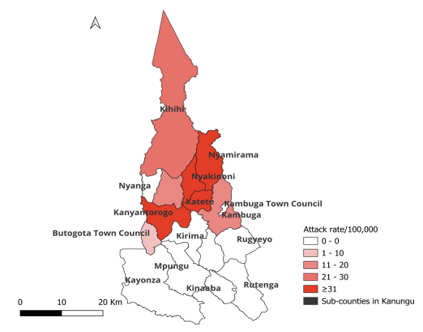
Cases occurred in the sub-counties of Kanungu District, with Nyamirama Sub-county recording the highest attack rate (86/100,000), followed by Nyakinoni Sub-county (79/100,000) (Figure 1).
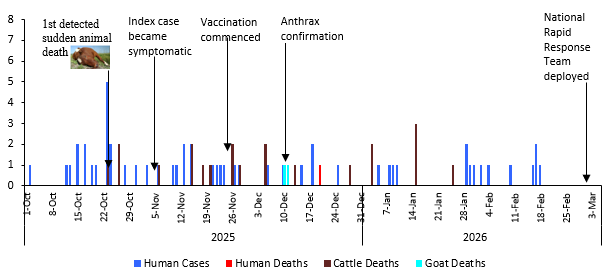
On October 23, 2025, a cow died suddenly in Katete Sub-county. On November 3, 2025, the index case presented to Kihihi HCIV. The outbreak peaked in mid-to-late November 2025. Laboratory confirmation of anthrax followed on December 10, 2025 (Figure 2). Animal deaths were followed by human cases.In response to the sudden animal deaths, a vaccination campaign began on November 24, 2025.
The National Rapid Response Team was deployed to the district on March 2, 2026 (Figure 2).
Hypothesis generation interview findings: We observed common exposures among 24 case-persons, of whom 75% had consumed meat from suddenly dead animals, 58% participated in trading or butchering cattle and 50% had carried butchered parts. With the results from descriptive analysis, we hypothesized consumption of meat from livestock that died suddenly drove the spread of anthrax.
Unmatched case-control study findings
At bivariate analysis, male sex, age ≥50 years, butchering of carcasses, meat dealer, cattle keeper, eating meat of livestock that died suddenly, skinning carcasses, and carrying butchered parts had p-values less than 0.2 and were taken into multivariate analysis (Table 1). At multivariate analysis, male sex (aOR=5.1, 95% CI: 1.4-19, p=0.010), and eating meat of livestock that died suddenly (aOR=6.4, 95% CI: 2.3–17, p<0.001) were significantly associated with anthrax.
Table 1: Bivariate analysis of risk factors for anthrax among cases and controls,
Kanungu District, Uganda, October 2025–March 2026
| Variable | Category | Cases n=24 n (%) |
Controls n=96 n (%) |
cOR (95% CI) |
| Sex | Male
Female |
21 (88)
3 (12) |
53 (55)
43 (45) |
5.7 (1.6-20)
Reference |
| Age group (years) | 15-29
30-49 ≥50 |
10 (41)
11 (46) 3 (13) |
27 (28)
32 (33) 37 (39) |
Reference
0.93 (0.34–2.5) 0.22 (0.05–0.87) |
| Meat dealer | Yes | 5 (21) | 8 (8) | 2.9 (0.85–9.8) |
| No | 19 (79) | 88 (92) | Reference | |
| Cattle keeper | Yes
No |
6 (25)
18 (75) |
8 (8)
88 (92) |
3.7 (1.1–11)
Reference |
| Ate meat of livestock that died suddenly | Yes
No |
17 (71)
7 (29) |
25 (26)
71 (74) |
6.9 (2.6–18)
Reference |
| Carried butchered parts | Yes
No |
4 (17)
20 (83) |
5 (5)
91 (95) |
3.6 (0.90–14)
Reference |
| Skinned carcasses | Yes
No |
7 (29)
17 (71) |
12 (13)
84 (87) |
2.9 (0.99–8.4)
Reference |
| Butchered carcasses | Yes
No |
11 (46)
13 (54) |
10 (11)
86 (89) |
7.2 (2.6–20)
Reference |
n-number of participants, cOR-crude odds ratio, CI-confidence interval
At multivariate analysis, male sex (aOR=5.1, 95% CI: 1.4-19, p=0.010), and eating meat of livestock that died suddenly (aOR=6.4, 95% CI: 2.3–17, p<0.001) were significantly associated with anthrax.
Discussion
Following the first-ever anthrax outbreak in Kanungu District from June–November 2024,
a second outbreak occurred from October 2025–March 2026, which was linked to consumption of meat from livestock that died suddenly. Additionally, being male significantly increased the odds of illness.
Consumption of meat from animals that died suddenly increased the odds of being a case. Our finding aligns with findings from previous studies on anthrax in Uganda. A study in Kiruhura District found out that consumption of infected meat was associated with six-fold increased odds of getting anthrax [6].
Male sex increased the odds of case status by about fivefold compared with female sex. Males in pastoral communities disproportionately perform high-risk activities such as slaughtering, butchering, skinning, and carcass disposal. Similar sex disparities have been documented in other studies with males being more affected than females [6-8].
Despite the implementation of livestock vaccination campaigns, enhanced surveillance, and community education following the 2024 outbreak, these measures proved insufficient to eliminate the conditions that continued to support anthrax transmission as they were not implemented beyond the outbreak period.
Study limitations: In this investigation, exposure information was self-reported and could not be independently verified, introducing potential recall bias. However, the biological coherence of the findings and their consistency with previous Ugandan outbreak investigations reduce the likelihood that recall bias alone explains these results. In addition, the small number of cases limited statistical power for the multivariate analysis. We used a 1:4 case to control ratio to increase statistical power.
Conclusion: Kanungu District experienced a recurrent anthrax outbreak associated with consumption of meat from livestock that died suddenly. Nyamirama Sub-county was the most affected. We recommend community education against consuming meat from sudden-death animals.
Conflict of interest: The authors declared no conflict of interest.
Authors’ contribution: All authors contributed to the write-up and review of the bulletin article. VJK drafted the initial version of the article. JW, PA, SN, DA, KDA, EM, AB, KMB participated in the data collection and case investigations and data analysis. RM, PE, and BK supervised the field data collection and reviewed the article for substantial intellectual content. All authors read and approved the final bulletin article.
Acknowledgements: We are so grateful to the management and staff of Kanungu District Local Government for their support in coordination of the outbreak response, providing access to health facilities and community entry during data collection. We also thank the Ministry of Health and the Uganda Public Health Fellowship Program for their technical support during this study.
Copyright and licensing: All materials in the Uganda Public Health Bulletin are in the public domain and may be used and reprinted without permission; citation as to source, however, is appreciated. Any article can be reprinted or published. If cited as a reprint, it should be referenced in the original form.
References
- Harioputro, D.R., et al., Cutaneous Anthrax: What is the Hallmark? Acta Med Indones, 2024. 56(4): p. 555-556.
- Denk, A., et al., Cutaneous anthrax: evaluation of 28 cases in the Eastern Anatolian region of Turkey. Cutan Ocul Toxicol, 2016. 35(3): p. 177-80.
- Hicks, C.W., et al., An overview of anthrax infection including the recently identified form of disease in injection drug users. Intensive Care Med, 2012. 38(7): p. 1092-104.
- Doganay, M., G. Metan, and E. Alp, A review of cutaneous anthrax and its outcome. J Infect Public Health, 2010. 3(3): p. 98-105.
- CDC, Laboratory Information for Anthrax Testing. 2026.
- Migisha, R., et al., Risk factors for human anthrax outbreak in Kiruhura District, Southwestern Uganda: a population-based case control study. 2021.
- Oketch, D.C., et al., Cultural and behavioral drivers of zoonotic disease transmission and persistence among diverse pastoralist communities in East Africa. One Health Outlook, 2025. 7(1): p. 36.
- Chowdhury, S., et al., Risk factors associated with cutaneous anthrax outbreaks in humans in Bangladesh. Frontiers in public health, 2024. 12: p. 1442937.

Comments are closed.