

Developing an Antibiogram to Strengthen Antimicrobial Stewardship at General Military Hospital-Bombo, Uganda, 2024
Authors: Robert Namisi Masamba1,2*, Ambrose Edmond Oiko1, Samuel Gidudu2, Ritah Namusoosa2, Joseph Nkodyo M3 Institutional affiliations: 1General Military Hospital–Bombo, Uganda Peoples Defense Forces (UPDF) Medical Services, Kampala Uganda, 2Uganda National Institute of Public Health, Ministry of Health, Kampala, 3National Health Laboratory and Diagnostics Services, Ministry of Health, Kampala-Uganda. * Correspondence: Tele: +256772859404, Email: masabanamisi@uniph.go.ug

Summary
Background: Antimicrobial resistance (AMR) is a major public health challenge in sub-Saharan Africa. Because antimicrobial susceptibility patterns vary across geographic areas and healthcare institutions, local surveillance is essential to guide empiric therapy and antimicrobial stewardship. We established an antibiogram for General Military Hospital Bombo (GMH)in 2024 to characterize local resistance patterns and inform appropriate empiric antibiotic use.
Methods: We conducted a hospital-based retrospective study at GMH Bombo using routine clinical microbiology data collected from 1 January to 31 December 2024. Laboratory records of confirmed bacterial isolates with complete antimicrobial susceptibility testing (AST) results were extracted and analyzed using the World Health Organization Network for Antimicrobial Resistance Surveillance Software (WHONET). Following the “first isolate only” principle and Clinical Laboratory Standards Institute (CLSI) M39 guidelines, descriptive analyses were performed to generate a facility-based cumulative antibiogram of antimicrobial susceptibility patterns among clinically significant bacterial isolates.
Results: The antibiogram for GMH-Bombo was successfully developed. Staphylococcus aureus (n=98) was the most frequently isolated species, followed by Escherichia coli (n=85), Klebsiella pneumoniae (n=46), and Enterococcus spp. (n=30). The most common specimen types from which these leading isolates were recovered were pus swabs and urine. The most sensitive drugs for Staphylococcus aureus were amikacin (100%) and cefuroxime (89%), while the highest resistance was observed to penicillin (5% sensitivity) and azithromycin (10% sensitivity). For Escherichia coli, amikacin (100%) and imipenem (97%) showed the highest sensitivity, while ampicillin (2%) and erythromycin (7%) showed the lowest sensitivity. For Klebsiella pneumoniae, nitrofurantoin (100%) and Ertapenem (85%) showed the highest sensitivity, while tetracycline (0%) and piperacillin (0%) showed the lowest sensitivity. Finally, for Enterococcus spp., cefuroxime (100%) and chloramphenicol (100%) showed the highest sensitivity, while erythromycin (0%) and amoxicillin-clavulanic acid (0%) showed the lowest sensitivity.
Conclusion: The GMH-Bombo antibiogram demonstrated substantial variation in antimicrobial susceptibility and provides locally relevant evidence to guide empiric antibiotic therapy and strengthen antimicrobial stewardship.
Introduction
Antimicrobial resistance (AMR) is a major global public health threat that reduces the effectiveness of antibiotics and contributes to increased morbidity, mortality, and healthcare costs [1,2,3,4,5$6]. In 2019, an estimated 1.27 million deaths globally were directly attributable to bacterial AMR, with sub-Saharan Africa experiencing a disproportionately high burden [7, 8]. Strengthening antimicrobial stewardship (AMS) and using local antimicrobial susceptibility data to guide treatment are therefore important strategies for preserving antibiotic effectiveness [9].
Uganda has established national AMR surveillance and promotes antimicrobial stewardship, including development of facility-specific cumulative antibiograms to guide empirical antibiotic treatment and monitor local resistance patterns [10, 11].
General Military Hospital (GMH)-Bombo is the national referral hospital for the Uganda Peoples’ Defence Forces and receives referrals from 105 lower-level UPDF health facilities [12]. Although its microbiology laboratory has conducted culture and antimicrobial susceptibility testing since 2012, the hospital had not developed a cumulative antibiogram. We developed a cumulative antibiogram using bacterial isolates from GMH-Bombo to describe local antimicrobial susceptibility patterns, inform empirical antibiotic selection, and strengthen antimicrobial stewardship.
Methods
We conducted a hospital-based retrospective analysis of routine microbiology data collected at General Military Hospital (GMH)-Bombo, the national referral hospital for the Uganda Peoples’ Defence Forces, from 1 January to 31 December 2024. GMH-Bombo is the only UPDF facility that routinely performs bacterial culture and antimicrobial susceptibility testing and receives referrals from UPDF health facilities across Uganda.
Data were abstracted from microbiology laboratory registers and included patient characteristics, specimen type, bacterial species isolated, antibiotics tested, and antimicrobial susceptibility results. We included confirmed bacterial isolates with complete susceptibility results and adequate documentation; fungal isolates were excluded. To minimize duplication, only the first isolate of a given bacterial species from each patient during the study period was included.
Data were cleaned in Microsoft Excel and analyzed using World Health Organization Network for Antimicrobial Resistance Surveillance Software (WHONET) version 2025. A cumulative antibiogram was developed in accordance with Clinical and Laboratory Standards Institute M39 guidance, and only bacterial species with at least 30 isolates were included. Antimicrobial susceptibility was summarized as the percentage of isolates susceptible to each antibiotic, with isolate counts reported as frequencies.
Administrative clearance to conduct the study and access the hospital was granted by ministry of Health of Uganda through the office of Director General of Health Services. Additional authorization was obtained from the leadership of GMH-Bombo to access clinical microbiology data. The activity was reviewed by the U.S. Centers for Disease Control and Prevention and determined not to constitute research. It was implemented in accordance with applicable U.S. federal laws and CDC policies, including 45 C.F.R. part 46.102(l)(2), 21 C.F.R. part 56, 42 U.S.C. §241(d), 5 U.S.C. §552a, and 44 U.S.C. §3501 et seq
Results
A total of 331 bacterial isolates representing 14 species were recovered during the study period. Of these, 259 (78%) isolates from four species met the CLSI M39 criteria for inclusion in the cumulative antibiogram: Staphylococcus aureus (n=98), Escherichia coli (n=85), Klebsiella pneumoniae (n=46), and Enterococcus spp. (n=30).
Staphylococcus aureus
Among 98 Staphylococcus aureus isolates, susceptibility was highest to linezolid (89%), chloramphenicol (86%), and nitrofurantoin (76%). Susceptibility was 69% to clindamycin, 58% to gentamicin, and 45% to ciprofloxacin. Lower susceptibility was observed to tetracycline (36%), ceftazidime and cefoxitin (33% each), erythromycin (27%), cefepime (25%), cotrimoxazole (23%), amoxicillin-clavulanic acid (17%), ampicillin (13%), and penicillin G (5%) (Table 1).
Escherichia coli
Among 85 Escherichia coli isolates, susceptibility was 100% to amikacin and tetracycline, 97% to imipenem, 93% to meropenem, and 84% to ertapenem. Susceptibility was 78% to chloramphenicol, 75% to nitrofurantoin, 67% to piperacillin, 66% to gentamicin, and 63% to cefepime. Lower susceptibility was recorded for ciprofloxacin (30%), ceftazidime (20%), ceftriaxone (17%), cefotaxime and cefuroxime (13% each), amoxicillin-clavulanic acid (9%), cotrimoxazole (7%), and ampicillin (2%) (Table 2).
Klebsiella pneumoniae
Among 46 Klebsiella pneumoniae isolates, susceptibility was highest to nitrofurantoin (100%), ertapenem (85%), meropenem (83%), and imipenem (81%). Susceptibility was 67% to amikacin, 59% to gentamicin, 57% to cefepime, 54% to chloramphenicol, and 53% to amoxicillin-clavulanic acid. Susceptibility was lower to ciprofloxacin (42%), ceftriaxone (28%), cefoxitin (25%), ceftazidime (10%), and cefotaxime and cefuroxime (9% each). No susceptibility was recorded to ampicillin, piperacillin, or tetracycline (Table 3).
Enterococcus spp.
Among 30 Enterococcus spp. isolates, susceptibility was 100% to chloramphenicol, linezolid, nitrofurantoin, and amikacin. Susceptibility was 58% to amoxicillin-clavulanic acid, 57% to vancomycin, and 50% to gentamicin and ampicillin. No susceptibility was recorded to ciprofloxacin, erythromycin, or cotrimoxazole (Table 4).
Overall susceptibility pattern
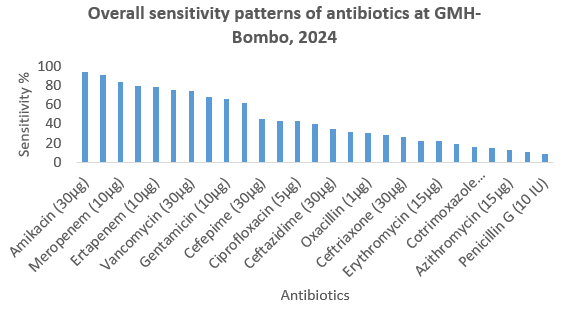
Across the four bacterial species, susceptibility varied widely by antibiotic. Several antibiotics had susceptibility below 40%, while the highest susceptibility values were observed for selected antibiotics including linezolid, chloramphenicol, nitrofurantoin, amikacin, and carbapenems (Table 5).
| Table 1: Antibiogram for Staphylococcus aureus (n = 98) | |
| Antibiotic | Sensitivity% |
| Linezolid(30µg) | 89 |
| Chloramphenicol(5µg) | 86 |
| Nitrofurantoin(300µg) | 76 |
| Clindamycin(2µg) | 69 |
| Gentamicin(10µg) | 58 |
| Ciprofloxacin(5µg) | 45 |
| Tetracycline(30µg) | 36 |
| Ceftazidime(30µg) | 33 |
| Cefoxitin(30µg) | 33 |
| Erythromycin(15µg) | 27 |
| Cefepime(30µg) | 25 |
| Cotrimoxazole (1.25/23.5µg) | 23 |
| Amoxycillin-clavulanic acid(20/10µg) | 17 |
| Ampicillin(10µg) | 13 |
| Penicillin G(10 units) | 5 |
| Table 2: Antibiogram for Escherichia coli (n=85) | |
| Antibiotic | Sensitivity |
| Amikacin(30µg) | 100 |
| Tetracycline(30µg) | 100 |
| Imipenem(10µg) | 97 |
| Meropenem(10µg) | 93 |
| Ertapenem(1g) | 84 |
| Chloramphenicol(5µg) | 78 |
| Nitrofurantoin(300µg) | 75 |
| Piperacillin(100µg) | 67 |
| Gentamicin(10µg) | 66 |
| Cefepime(30µg) | 63 |
| Ciprofloxacin(5µg) | 30 |
| Ceftazidime(30µg) | 20 |
| Ceftriaxone(30µg) | 17 |
| Cefotaxime(30µg) | 13 |
| Cefuroxime(Oral),(30µg) | 13 |
| Amoxycillin-clavulanic acid(20/10µg) | 9 |
| Cotrimoxazole (1.25/23.5µg) | 7 |
| Ampicillin(10µg) | 2 |
| Table 3: Antibiogram for Klebsiella Pneumoniae (n=46) | |
| Antibiotic | Sensitivity% |
| Nitrofurantoin(300µg) | 100 |
| Ertapenem(1g) | 85 |
| Meropenem(10µg) | 83 |
| Imipenem(10µg) | 81 |
| Amikacin(30µg) | 67 |
| Gentamicin(10µg) | 59 |
| Cefepime(30µg) | 57 |
| Chloramphenicol(5µg) | 54 |
| Amoxycillin-clavulanic acid(20/10µg) | 53 |
| Ciprofloxacin(5µg) | 42 |
| Ceftriaxone(30µg) | 28 |
| Cefoxitin(30µg) | 25 |
| Ceftazidime(30µg) | 10 |
| Cefotaxime(30µg) | 9 |
| Cefuroxime(Oral),(30µg) | 9 |
| Ampicillin(10µg) | 0 |
| Piperacillin(100µg) | 0 |
| Tetracycline(30µg) | 0 |
| Table 4: Antibiogram for Enterococcus spp (n = 30) | |
| Antibiotic | Sensitivity% |
| Chloramphenicol(5µg) | 100 |
| Linezolid(30µg) | 100 |
| Nitrofurantoin(300µg) | 100 |
| Amikacin(30µg) | 100 |
| Amoxycillin-clavulanic acid(20/10µg) | 58 |
| Vancomycin(30µg) | 57 |
| Gentamicin(10µg) | 50 |
| Ampicillin(10µg) | 50 |
| Ciprofloxacin(5µg) | 0 |
| Erythromycin(15µg) | 0 |
| Cotrimoxazole (1.25/23.5µg) | 0 |
Discussion
The GMH-Bombo antibiogram showed substantial resistance to several commonly used antibiotics. Staphylococcus aureus, Escherichia coli, Klebsiella pneumoniae, and Enterococcus spp. were the most frequently isolated organisms. Susceptibility to several commonly used agents, including ampicillin, penicillin, azithromycin, amoxicillin-clavulanate, and ceftriaxone, was low, limiting their usefulness for empirical treatment.
Resistance was particularly notable among E. coli and K. pneumoniae, while reduced susceptibility was also observed to selected last-line agents, including carbapenems and vancomycin. These findings highlight the need for continued antimicrobial resistance surveillance and strengthened antimicrobial stewardship to preserve the effectiveness of available treatment options. The cumulative antibiogram provides facility-specific evidence that can support empirical antibiotic selection and guide stewardship interventions at GMH-Bombo.
Study limitation: Only organisms with at least 30 isolates were included in the cumulative antibiogram in accordance with CLSI M39 guidance. Consequently, less frequently isolated organisms, including some with extensive drug resistance, were not presented and may represent clinically important resistance patterns requiring separate review.
Conclusion: The GMH-Bombo antibiogram demonstrated high resistance to several routinely used antibiotics, with reduced susceptibility observed among important bacterial pathogens. Facility-specific antibiograms can support empirical treatment decisions and strengthen antimicrobial stewardship. GMH-Bombo and other facilities with microbiology capacity should routinely develop and use cumulative antibiograms to guide empirical treatment. These data should be incorporated into antimicrobial stewardship activities, hospital treatment guidelines, and national AMR surveillance systems. Clinicians should also be encouraged to use culture and susceptibility results whenever available, particularly for severe or difficult-to-treat infections.
Conflict of Interest: The authors declare no conflict of interest
Author contribution: MRN lead in project developing, data collection, analysis and initial draft, writing. AEO gave permission for access to raw data and field supervision, JN supervised the write-up, SG, and RM.
Acknowledgements: The authors appreciate General Military Hospital for granting access to microbiology data that was used for this study.
Copyright and licensing: All materials in the Uganda Public Health Bulletin are in the public domain and may be used and reprinted without permission; citation as to source, however, is appreciated. Any article can be reprinted or published. If cited as a reprint, it should be referenced in the original form.
References
- Prestinaci F, Pezzotti P, Pantosti A, Antimicrobial resistance: a global multifaceted phenomenon, Pathog Glob. Health 109 (2015) 309–318, https://
doi.org/10.1179/2047773215Y.0000000030.
- Ferdinand A.S., McEwan C., Lin C., Betham K., Kandan K., Tamolsaian G.,
Pugeva B., McKenzie V, Browning G., Gilkerson J., Development of a crosssectoral antimicrobial resistance capability assessment framework, BMJ Glob.
Heal 9 (2024) e013280
- Salam M.A., Al-Amin M.Y., Salam M.T., Pawar J.S., Akhter N., Rabaan A.A., Alqumber M.A.A. (2023). Antimicrobial resistance: a growing serious threat for global public health. Health, 11: 1946.
- Naghavi M., Vollset S.E., Ikuta K.S., Swetschinski L.R., Gray A.P., Wool E.E., Aguilar G.R., Mestrovic T., Smith G., Han C. (2024). Global burden of bacterial antimicrobial resistance 1990–2021: a systematic analysis with forecasts to 2050. Lancet, 404: P1199– 1226.
- Ruckert A., Lake S., Van Katwyk S.R. (2024). Developing a protocol on antimicrobial resistance through WHO’s pandemic treaty will protect lives in future pandemics. Global. Health, 20: 10.
- Puopelle Dakorah1*, Elizabeth Agyare1 , Joseph Elikem Efui Acolatse1*, George Akafity1 , John Stelling2, Victoria J. Chalker3, Owen B. Spiller4 , Nana Benyin Aidoo1 , Frederick Kumi‑Ansah1 , Daniel Azumah1, Stephen Laryea1 , Robert Incoom1 and Eric Kofi Ngyedu1: Utilizing cumulative antibiogram data to enhance antibiotic stewardship capacity in the Cape Coast Teaching Hospital, Ghana Antimicrobial Resistance & Infection Control (2022) 11:122 https://doi.org/10.1186/s13756-022-01-160-3
- Godman B, Egwuenu A, Haque M, Malande OO, Schellack N, Kumar S, et al. Strategies to improve antimicrobial utilization with a special focus on developing countries. Life. 2021;11(6):1–43.
- World Health Organization. Regional office for South-East Asia. Step-by step approach for development and implementation of hospital antibiotic policy and standard treatment guidelines. New Delhi: WHO Regional Office for South-East Asia; 2011. p. 49.
- Clinical Laboratory Standards Institute guidelines M39-A3 third edition: New guidelines for cumulative antimicrobial susceptibility test data; February 16, 2009
- Government of Uganda. (2024). Antimicrobial Resistance National Action Plan II, 2024–2029.
- Karakonstantis S, Kalemaki D. Antimicrobial overuse and misuse in the community in Greece and link to antimicrobial resistance using methicillin-resistant S. aureus as an example. Journal of Infection and Public Health. 2019;12(4):460-4.
- Okello P, Agwa E, Yonah M. Endemicity of Malaria parasites among Tuberculosis infected HIV patients attending Bombo Military Hospital, Luwero district, Uganda. Special Parasites Pathogens J. 2015;1(1):021-28 [Google Scholar]

Comments are closed.